

Guard Rail Fall Protection: What You Need to Know
Work on your roof that happens regularly or takes longer than two hours requires fall protection. Your requirement to provide a safe working surface for individuals on the roof is outlined in OSHA’s 29 CFR 1910 Subpart D – Walking-Working Surfaces. While you have many options to choose from to protect workers today, guard rail continues to be a trusted solution. If you’re considering adding guard rail to your roof, D. C. Taylor Co.’s Vice President Service James (J.J.) Longerbeam has answers to all your questions.
Q: Why is guard rail a good option if you have people working on the roof?
A: Guard rail is the ideal choice for facility managers and building owners who have their own people or contractors working on the roof. It’s simple, reliable, passive fall protection that keeps workers safe without requiring special equipment or extensive training. It corrals workers into the work zone and away from the roof edge.
Q: How do you determine where to put guard rail on the roof?
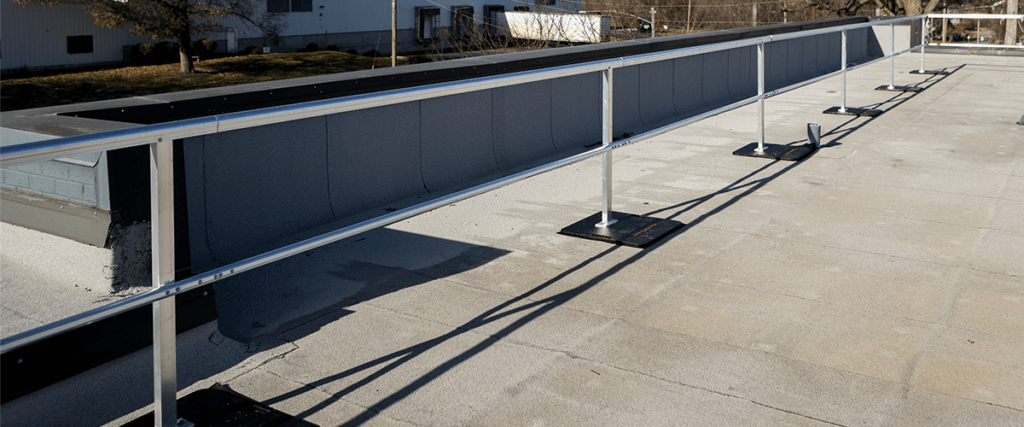
A: Guard rails should be installed around all unprotected roof edges and openings where the workers are exposed to fall hazards. In a perfect world, it’s nice to put it around the entire perimeter of the roof. When budgets are tight, I like to mix guard rail and warning line, which comes in 100-foot sections. It’s a vertical stanchion, steel cable, and heavy-duty plastic flags. Typically, you’d locate those every 20-25 feet on center. We put the warning line 15 feet in from the edge to alert workers to the fall hazard. It’s a big cost savings for the customer.
The only disadvantage to warning lines is that they’re easy to lift and step under. Have a designated safety monitor present to prevent individuals from stepping between the line and the roof edge. And you should always define and enforce a designated work area policy. Communicate the requirement to stand inside the flag line and the dangers present otherwise.

Q: Why choose weighted guard rail vs. penetrating or parapet guard rail?
A: With weighted guard rail, there’s no penetration into the roof system. It’s ideal for temporary, infrequent access and comes with a lower initial cost. It’s portable, movable, and suitable for short-duration work. You can even include sections with a hinged gate, too.
Penetrating or parapet guard rail is more expensive. You’ve got to secure it to the roof or mount it to the perimeter. If it’s mounted to the parapet wall, you have to take the coping cap off. It may require all new coping cap or a reinforced wood structure for mounting. Penetrating or parapet guard rail adds to the time and expense of reroofing, too.
Q: Is guard rail pretty standard, or are there things facilities professionals should know to get the right guard rail for their needs?
A: We have three to four manufacturers we work with when installing guard rail on customers’ facilities. Their products are all somewhat standard in their core safety specifications. The 42-inch height, plus or minus 3 inches, is standard. All guard rail must be able to withstand 200 lbs. of outward or downward force. And cost-wise, they’re all very reasonable within literally dollars of each other. There are a lot more color options now than ever before, but your standard will be powder-coated gray or safety yellow.
Q: Are there any maintenance or inspection requirements for guard rail?
A: OSHA says guard rail must be inspected regularly for signs of damage, wear, corrosion, and structural weakness that could compromise its strength or stability. It’s very durable, though. It would take a piece of equipment or something massive to hit it forcefully enough to damage or crack it.
Regularly, you’ll want to look at the top rail and mid rail for any corrosion or cracks. Obviously, then, that section would need to be replaced, but it’s pretty weatherproof, for the most part. Like anything else, of course, 10 years out in the weather, it’s going to have some rusting and fading from the UV.

Certain guard rail has pins where the vertical post separates from the mid rail and top rail; everything’s pinned or nut-and-bolted together. In others, where it goes down into the base, you put a pin in to secure it, and the pin locks. Make sure the cotter pins and everything are in place during a visual inspection.
The space between guard rail balusters cannot be bigger than 4 inches. Most of the standard bases come with four different slots to put the guard rail down into, and you need to make sure they’re right next to each other. You don’t want to skip two because then you’ve got an 8- or 12-inch gap that, say, a small child or a piece of equipment could fit through; that’s not safe.
Make checking the condition of your guard rail part of your regular roof inspection.
Q: Any words of caution?
A: Some people think, “Oh well, I can just buy guard rail from a product distributor and get it installed.” When that happens, there’s no design. In these situations, there is often hardware missing that’s needed to do the installation. (You often need extra bases because you have outriggers whenever you have a start or stop.) I recommend hiring a professional to do the design layout, ordering, and installation. D. C. Taylor Co. has a mobile anchor on wheels that we pull along with us as we’re doing the installation, so we’re tied off the whole time at the perimeter edge. You don’t want to have people doing the installation at the perimeter with no fall protection. That defeats the purpose.
It can be daunting to assess hazards and determine the most appropriate fall protection; D. C. Taylor Co. can help. Contact us today at 319.731.4118 or [email protected] to schedule a Safe Roof Audit.
 Previous