

The Most Dangerous Parts of Your Roof (and Fall Protection to Reduce the Risk)
According to the U.S. Department of Labor’s Occupational Safety and Health Administration (OSHA), falls are the leading cause of death in construction. Working at a height is a considerable safety risk. When accessing, exiting, and working on the roof, there’s an increased probability of injury. We talked with our Safety Manager Kirk Dighton for an overview of the areas that pose the greatest risk and the strategies and equipment that building owners can use to decrease the danger.
Roof Hatch
A roof hatch becomes an open hole that creates a fall-through hazard. “People tend to leave the roof hatch open. It should have a guard rail around it with a swing-out gate that comes back closed after you go through it,” says Dighton. Alternatively, you can install a flag line around the roof hatch to warn of danger, but since these can fall over and are easily lifted to step under, a guardrail around a roof hatch is the safest strategy to protect workers.

Ladders
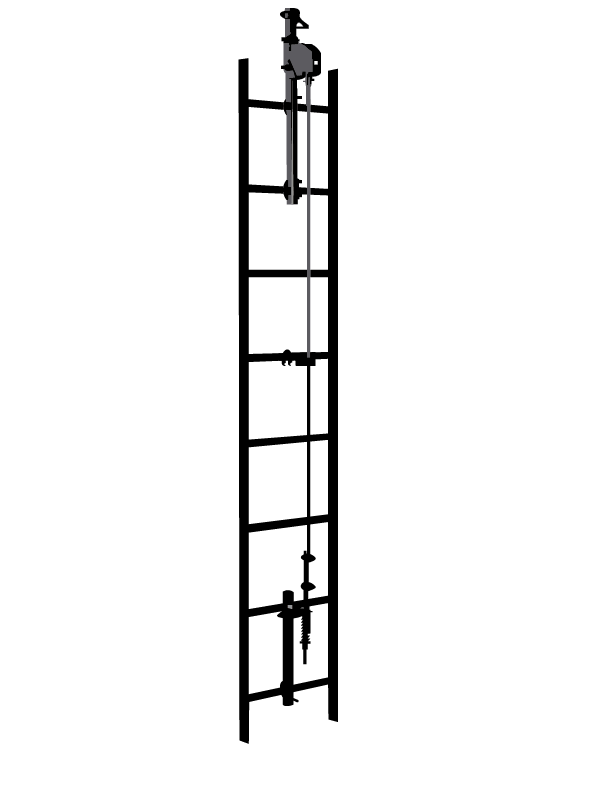
While the OSHA 1910.28(b)(9)(i) guideline requiring a ladder safety system on existing ladders doesn’t take effect until November 18, 2036, Dighton strongly encourages employers to increase the safety of their fixed ladders with a personal fall arrest system or ladder safety system. Individuals connect to the systems either via a front or back D-ring on their body harness. If they lose contact with the ladder, the system locks in place to prevent them from falling more than a few feet.
If using an extension ladder, make sure the ladder is placed on an even surface, installed at a 4:1 ratio, secured at the top to a rigid structure, and that ladder rails extend a minimum of 36 inches above the landing. Train users on proper use. Individuals should maintain three points of contact at all times when using a ladder.
Skylights
OSHA classifies skylights as holes, and employers must protect rooftop workers from the possibility of falling through them. “As soon as anyone sets foot on the roof, the hazard is present and they must be protected,” notes Dighton. Guardrails are a good option for mitigating this risk, another is permanent skylight screens. OSHA 1926.502(i)(2) specifications require skylight screens to be capable of supporting, without failure, at least twice the weight of employees, equipment, and materials. Temporary skylight nets should only be used as a short-term solution because the netting breaks down over time.

Perimeter Edge
Falling from the perimeter edge is the most obvious threat to safety on the roof and has the greatest number of options for mitigation. A horizontal lifeline (HLL) and single-point roof anchor can both reduce injury from a fall or prevent one from happening altogether; however, they each require that individuals wear personal protective equipment (i.e., a body harness and fall restraint lanyard). These systems require that users undergo Authorized User training and not only have the necessary PPE but also fit it properly and inspect it regularly.
When inviting a contractor (e.g., HVAC, security, etc.) onto your roof to perform work, inform them that the roof has an HLL or single-point roof anchors and that you expect them to bring proper PPE and be trained in the use of this equipment.
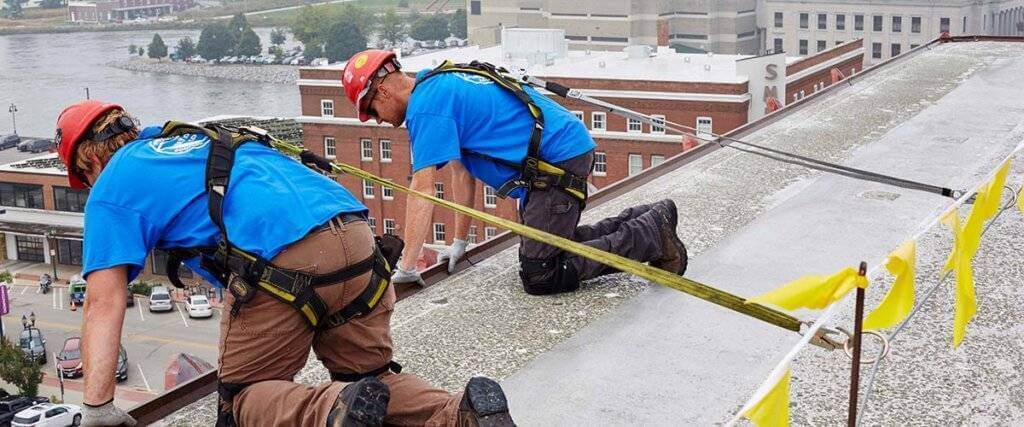
Dighton recommends the use of guardrails as an alternative to these active fall protection systems. “Guardrail is a passive system. You don’t have to rely on employees to administer the equipment and PPE correctly,” he says. It simply provides a barrier to prevent employees from getting too close to the edge.

Grade Changes
Even small changes in the level from one roof area to another can cause injuries. “Any change in elevation starting at 19 inches and greater, you need to have some sort of platform or step to access and egress that transition,” Dighton explains. And while you don’t need the same perimeter edge protection for a 36-inch drop, you must provide some visual indicator to alert workers to the grade change. Dighton suggests a walkway pad as a cue to individuals to stay on the allotted path and a warning line or orange cones as additional measures.
Your requirement to provide a safe working surface for individuals on the roof is outlined in OSHA’s 29 CFR 1910 Subpart D – Walking-Working Surfaces. It can be daunting to assess the hazards and determine the most appropriate fall protection; D. C. Taylor Co. can help.
Contact D. C. Taylor Co. today at 319.731.4118 or [email protected] for a safe roof audit and/or permanent fall protection installation.
 Previous